ADVERTISEMENT
A timeline of MLB’s failed negotiations
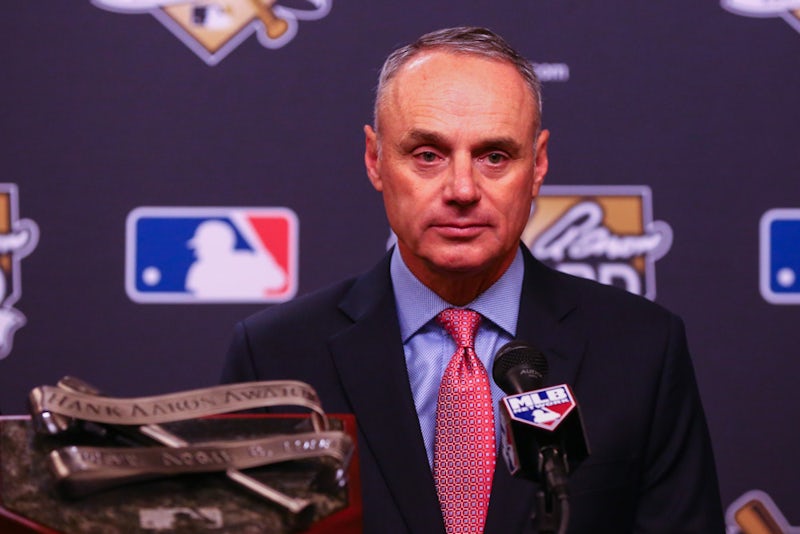
MLB Commissioner Rob Manfred. (Photo by Rich Graessle/Icon Sportswire)

June 19th, 2020
Almost every major sport has extended some type of proposal for a restart amid the COVID-19 pandemic. No league has looked more ill-equipped to handle such a task than Major League Baseball.
Since MLB announced the suspension of spring training and delayed the start of the regular season, commissioner Rob Manfred and the Players Association have squabbled over a plan to resume play, all the while garnering a ton of negative press.
Here is a timeline of every major offer that has been placed on the table.
March 12: League suspension
Let’s start at the beginning. One day after Rudy Gobert tested positive for COVID-19 before a Utah Jazz game, the MLB followed suit with other major sports leagues and halted play.
Spring training was suspended, and the league announced at least a two-week delay to the start of the regular season.
MLB: Spring training suspended. Opening day delayed by at least two weeks. pic.twitter.com/nzuoswxzUN
— Shannon Murray (@ShannonMFox4) March 12, 2020
March 27: Initial agreement becomes core of dispute
It seemed the MLB owners and players were well on their way to a feasible plan, when the two sides agreed to a deal that granted players a pay advance and assured them full service time and prorated salaries in the event of a shortened season.
It also guaranteed service time for 2020, equal to what a player earned in 2019, in the event the MLB was unable to play a shortened season.
Part of this initial agreement stated that a 2020 season would not begin until there are no circumstances that “materially limit the clubs’" ability to play games in front of spectators.”
The agreement also indicated “the Office of the Commissioner and Players Association will discuss, in good faith, the economic feasibility of playing games in the absence of spectators or at appropriate substitute neutral sites.”
Here’s where the major dilemma began.
I've spoken to a lot of players recently, and the message is the same: "Tell us when and where." Many have also cited what @JeffPassan refers to, that MLB is not "using best efforts to play as many games as possible," as mandated by the March 27 agreement. https://t.co/XdvGQjFzeA pic.twitter.com/VGI6l5BYTp
— Marly Rivera (@MarlyRiveraESPN) June 16, 2020
May 11: Sean Doolittle takes to Twitter
Throughout April and May, the United States saw a dramatic increase in COVID-19 cases, as well as a soaring unemployment rate.
The MLB tossed around the idea of resuming play without fans at spring training sites in Arizona or Florida. The owners proposed a shortened season that would begin around July 4. Players would receive the percentage of their salaries based on a 50-50 share of revenue, which went against the initial agreement in March.
This did not go over well.
We don't have a vaccine yet, and we don't really have any effective anti-viral treatments. What happens if there is a second wave? Hopefully we can come up with BOTH a proactive health plan focused on prevention AND a reactive plan aimed at containment.
— Obi-Sean Kenobi Doolittle (@whatwouldDOOdo) May 11, 2020
May 14, Bryce Harper and Blake Snell react
First, Tampa Bay Rays pitcher Blake Snell spoke out against the 50-50 revenue split and said the risk of contracting the coronavirus was "just not worth it," especially when playing for a reduced salary.
A day later, Bryce Harper reiterated the statement and praised Snell for speaking up against the owners' attempt to renegotiate financial compensation.
Blake Snell said: “For me to take a pay cut is not happening, because the risk is through the roof”
— John Clark (@JClarkNBCS) May 15, 2020
Bryce Harper reacts tonight ⬇️
“He ain't lying, he's speaking the truth bro. I ain't mad at him”https://t.co/4SLH3Zf4NR
The state of the MLB had now turned into a billionaires-versus-millionaires battle, and it hardly seemed appropriate in the midst of a global health crisis and record unemployment in the U.S.
May 26: First official offer
The owners offered to pay players on a sliding scale. Players who earned the league minimum ($563,500) would make 72.5% of their prorated salary, while players making more than $20 million would receive 20% of their prorated salaries.
The season would be shortened to 82 games, as well.
Potential salary cuts in MLB plan, sources tell @JesseRogersESPN and me:
— Jeff Passan (@JeffPassan) May 26, 2020
Full-year Proposal
$563.5K $262K
$1M $434K
$2M $736K
$5M $1.64M
$10M $2.95M
$15M $4.05M
$20M $5.15M
$25M $6.05M
$30M $6.95M
$35M $7.84M
May 31: Players Association makes offer
Still disgruntled over pay, the Players Association insisted financial compensation had been agreed to March 26. The only thing missing now is a date to resume play.
The players called for a 114-game regular season and fully prorated salaries. They also asked for a salary deferral plan, in the event the postseason is canceled or shortened.
The players also suggested an expanded postseason, both in 2020 and 2021, to help compensate for financial losses. Under the expanded format, 14 teams would make the playoffs.
Every player would also have the right to opt out of participating in a 2020 season.
June 8: Owners counter
MLB hardly improved its sliding scale, offered a 76-game regular season, and added two more playoff teams, to bring the number to 16. It further stipulated that, if a second wave of coronavirus caused the league to cancel the postseason, players would receive 50% of prorated pay for the regular season.
Report: MLB makes a new proposal to the players for a return to play and the union considers it a worse offer than the last. https://t.co/EFqnILXdPn pic.twitter.com/RzYyJGVRQH
— NBCSports Washington (@NBCSWashington) June 8, 2020
June 9: Players Association's rebuttal
One day later, the Players Association presented a deal. It called for 89 games in the regular season, with full prorated pay. It also agreed to a 16-team playoff in both 2020 and 2021.
June 12: MLB back with another offer
The owners proposed a 72-game season, with a 16-team playoffs, and up to 83% prorated salaries. By shortening the season, the increase in prorated salaries hardly made a difference.
June 15: Manfred 'not confident' a season will happen
Less than a week after he declared a 2020 season would happen, Manfred walked back that statement in an ESPN interview.
"You can't make this up if you tried! Rob Manfred has the nerve on June 15th to tell Mike Greenberg that he's not convinced there's even going to be a season."@AdamSchein starts the show off with the news that Rob Manfred isn't positive there will be a baseball season. pic.twitter.com/3ayA23xfqd
— CBS Sports Network (@CBSSportsNet) June 15, 2020
June 17: Light at the end of the tunnel?
Manfred and Players Association leader Tony Clark reportedly had a productive face-to-face meeting. The owners allegedly agreed to pay players full prorated salaries and create an expanded playoffs. The regular season would include 60 games.
Major League Baseball has sent a new proposal to the MLB Players Association, sources tell ESPN. No deal is done, but with Rob Manfred and Tony Clark having met, this is seen as significant progress considering where the parties were 48 hours ago.
— Jeff Passan (@JeffPassan) June 17, 2020
June 18: Players insist on more than 60 games
Clark released a statement that the players want at least 70 regular-season games and agree to an expanded playoff system in 2020 and 2021.
Among the details in MLBPA’s new proposal, sources tell ESPN:
— Jeff Passan (@JeffPassan) June 18, 2020
- 70-game season from July 19-Sept. 30
- $50M in playoff bonuses
- 50/50 split of new postseason TV revenues in 2021
- Forgiveness of salary advance for Tier I-III players
- Universal DH
- Mutual waiver of grievance
The latest development doesn't provide a clear-cut answer as to whether the MLB and players will come to an agreement, but the potential is there.
Until then, the circus continues, with the threat of an abandoned season growing each day.
Check back for the latest MLB odds at BetAmerica
ADVERTISEMENT